


Is it still working?
A two-week check that separates a dead softener from a tired one.
Guide · Softener upkeep
Most bridges are a fix you can make yourself. If the softener itself is worn out, we install replacement softeners.
You keep pouring salt into the brine tank, the tank looks full, and yet the water feels hard again. In many Kenosha basements the culprit is a salt bridge: a hollow crust of fused salt that hangs above the water, so the softener can no longer make brine. It is one of the easiest softener problems to fix yourself, as long as you work carefully.
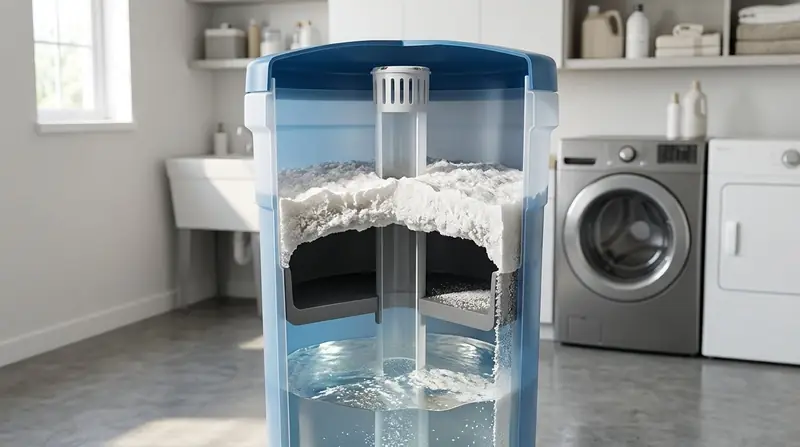
Salt pellets sit in the brine tank above a small pool of water. During regeneration the softener draws that water out as brine and refills it. Normally, the salt slowly dissolves from the bottom and the pile settles downward. A bridge forms when the upper layer of salt absorbs moisture, softens, then hardens again into a solid arch. The salt below dissolves away and leaves an empty cavity under the crust.
Two conditions encourage that cycle, and Kenosha homes see both. Summers near Lake Michigan are often humid, and basements stay damp. Winters bring big temperature swings between a warm house and a cold floor. Moisture condenses on the salt, then dries, again and again. A tank that is always filled to the brim makes things worse, because the top layer never gets a chance to dissolve.
Salt quality plays a part too. Pellets with more insoluble material, or a switch between salt types, can leave residue that knits the top layer together.
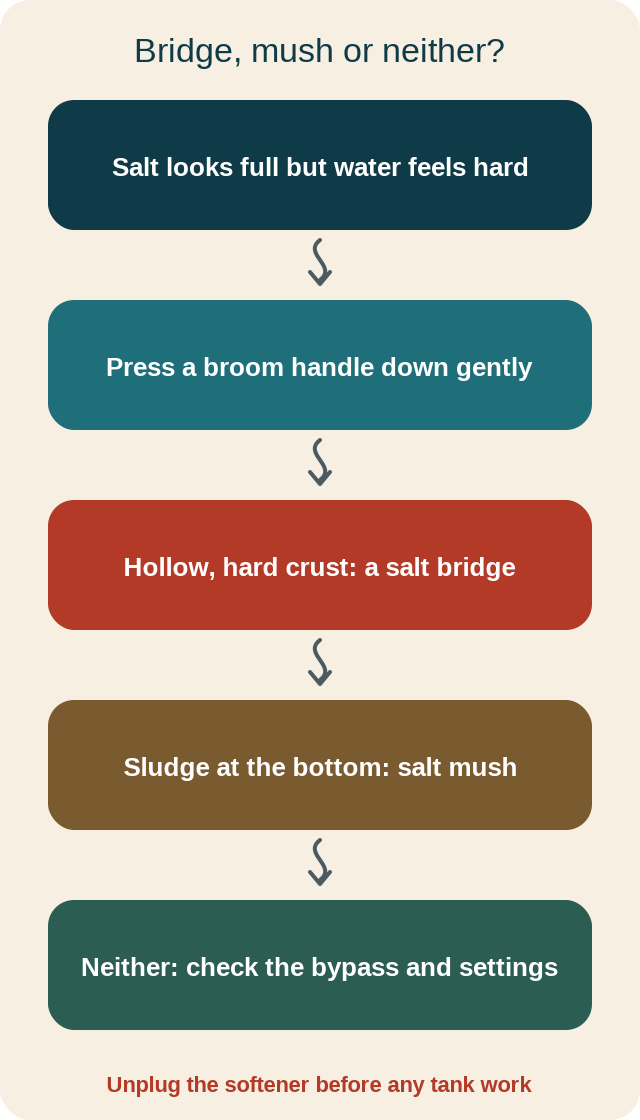
Before breaking anything up, figure out what you are dealing with. Unplug the softener, lift the lid and look. Then take a broom handle and press down gently in a few spots. If it meets a solid layer that gives way with a hollow feel, that is a bridge.
If the handle sinks easily but meets a thick, pasty layer at the bottom, that is salt mush: recrystallized salt that has settled and set like wet sand. Mush blocks the brine intake from below rather than above, and it usually means the tank needs cleaning, covered in the brine tank guide.
If you find neither, the salt is not the problem. Check that the bypass valve is set to service, that the clock or settings are correct after any power cut, and that the brine line is not kinked. The decision path in the diagram sums it up.
Disconnect power and set the bypass so the softener is out of service while you work.
Press or tap the crust with a broom handle until it cracks. Avoid sharp tools and hard blows, which can crack a plastic tank or damage the brine well inside.
Push large chunks down into the water so they can dissolve. Scoop out any that will not break.
After a while there should be water in the bottom of the tank. If there is far too much, the float or valve may need attention.
Restore power, return the bypass to service, start a manual regeneration, and test the water the next day.
If the crust will not break with gentle pressure, or the tank looks cracked or overfilled with water, stop and get help. A stuck valve or failed float is a different repair.
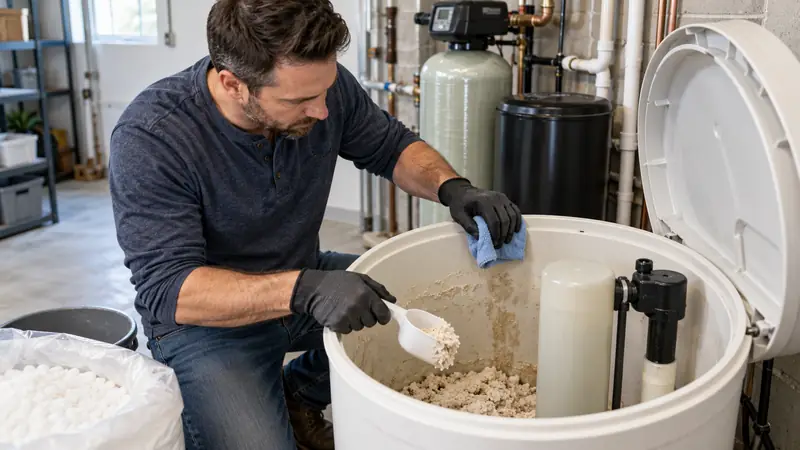
Prevention mostly comes down to salt level and habit. Keep the tank about half full rather than heaping it to the top, and check it once a month with a gentle push of the handle. In humid months, look more often. A small dehumidifier in a damp Kenosha basement helps the softener as much as it helps anything stored nearby.
Stick with one type of quality softener salt that the manufacturer of your unit recommends, and avoid mixing types in the same tank. If bridges keep returning despite all this, a tank cleaning resets things and gives you a clean start.
Write the date on the tank lid each time you add salt. It turns the salt level into a trend you can read, and a level that stops dropping becomes obvious long before the spots come back.
Sources: Penn State Extension, Water Softening (2025); Minnesota Department of Health, Home Water Softening (2022); manufacturer owner manuals for typical salt-level guidance.
Once a month is a good habit, and more often in humid summer months.
Not directly, but while it lasts the resin is not being recharged, so hard water reaches your fixtures.
Higher-purity pellets can help, but salt level and humidity matter more. Follow the softener maker’s salt advice.
A two-week check that separates a dead softener from a tired one.
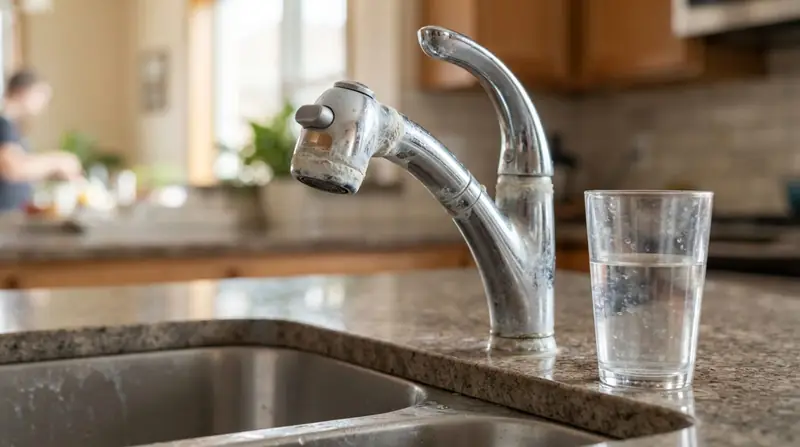
Read the white spots, then measure before you buy.

Resin, brine and regeneration explained without the jargon.
Get in touch
Call to talk through what to check next. If the softener itself is failing, we also replace older units.
Call 262-671-3513 Map location: 611 56th St Kenosha, WI 53140Send a message
Share your question and contact details in the form below.